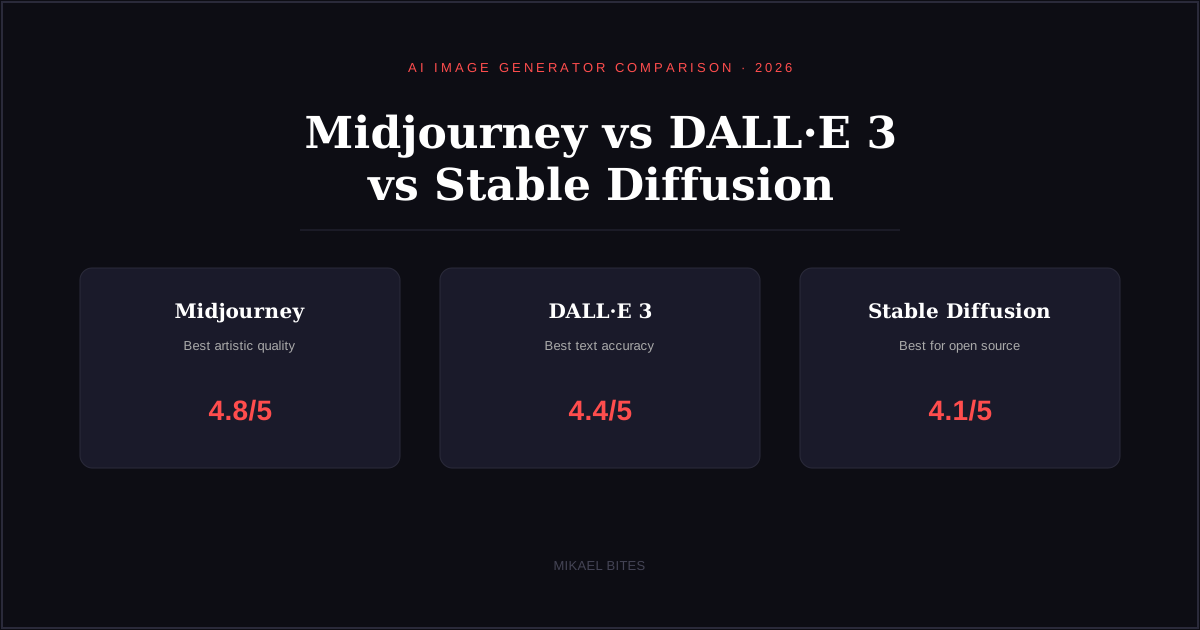
In the Midjourney vs DALL-E 3 vs Stable Diffusion matchup, Midjourney wins on raw image quality and artistic polish, DALL-E 3 wins on prompt understanding and ease of use inside ChatGPT, and Stable Diffusion wins on cost and control if you're willing to learn the tools. For most bloggers and marketers who just want the best-looking image with the least fuss, Midjourney is the one I keep coming back to.
Quick Comparison Table
| Feature | Midjourney | DALL-E 3 | Stable Diffusion |
|---|---|---|---|
| Starting price | $10/month | Included with ChatGPT Plus ($20/month) | Free (self-hosted) or ~$10/month via hosted apps |
| Image quality | Excellent, most "artistic" output | Very good, more literal | Good to excellent, depends on model |
| Prompt understanding | Good, needs some prompt skill | Best-in-class, understands plain English | Fair, benefits from prompt engineering |
| Ease of use | Moderate (Discord or web app) | Very easy (chat interface) | Hard (needs setup or third-party app) |
| Commercial use rights | Yes, on paid plans | Yes | Yes, model-dependent |
| Local/offline generation | No | No | Yes |
| Best for | High-quality artistic and marketing images | Beginners who want fast, accurate results | Developers and power users who want control |
Overview: Midjourney
Midjourney is the AI image generator most people mean when they say an image "looks AI-generated" in the best possible way — dramatic lighting, rich detail, and a level of polish that other tools still struggle to match. It runs through Discord or its own web app, and you generate images by typing a text prompt into a command.
I've used Midjourney for blog featured images, mockups, and concept art, and the quality difference versus other tools is obvious the moment the grid comes back. Version 6 and later versions narrowed the prompt-understanding gap with DALL-E 3, so you no longer need to speak fluent "prompt-ese" to get something usable. It still rewards specificity — mentioning camera angle, lighting, and style noticeably improves results — but the baseline output quality is high even with simple prompts.
The tradeoff is workflow. Midjourney's web app has made things easier, but it's still not as frictionless as typing into a chat window. For anyone comparing Midjourney vs DALL-E 3 vs Stable Diffusion specifically for finished, publish-ready images, Midjourney is usually the fastest path to something that looks professional without any editing.
Try Midjourney free — actually, there's no free tier anymore, but every paid plan starts at just $10/month, which is cheap for the quality you get. Join Midjourney — starts at $10/month →
Overview: DALL-E 3
DALL-E 3 is OpenAI's image generator, and its biggest advantage isn't image quality — it's understanding what you actually asked for. Because it's built into ChatGPT, you can describe an image in plain, conversational English ("a cozy home office with warm morning light, a laptop, and a coffee mug, flat lay from above") and get something close to that description on the first try.
This is the tool I reach for when I need an image that has to match a specific idea exactly — a diagram-style illustration, a product mockup with particular objects in it, or anything where getting the composition "wrong" would mean starting over. DALL-E 3's weakness is that its output can look a little flatter and more generic than Midjourney's, especially for anything meant to look like premium photography or fine art.
Access requires a ChatGPT Plus subscription at $20/month, which also gets you GPT-5-class chat, so if you're already paying for ChatGPT, DALL-E 3 is essentially a free add-on rather than a separate cost.
Overview: Stable Diffusion
Stable Diffusion is different from the other two in one key way: it's open-source, and you can run it on your own hardware or through third-party hosted apps like Leonardo AI or Playground. That gives it two big advantages — cost and control. You can fine-tune models on your own images, use community-trained checkpoints for specific styles, and generate images with no per-image or subscription cost if you're running it locally.
The catch is setup. Running Stable Diffusion locally means installing software, downloading models, and dealing with GPU requirements — not something most bloggers want to spend an afternoon on. Hosted versions through apps like Leonardo AI smooth this out and get you closer to a Midjourney-style experience, but you're now paying a subscription again, which erodes the "free" advantage.
Image quality varies more with Stable Diffusion than with the other two, because it depends heavily on which model and settings you use. With a well-chosen model and a dialed-in prompt, output can rival Midjourney. With defaults and a lazy prompt, it often looks noticeably rougher.
Features Head-to-Head
Prompt understanding. DALL-E 3 leads here by a clear margin — it interprets natural language prompts more accurately than the other two, including negatives ("no text," "no people") and specific counts of objects. Midjourney has closed most of the gap in recent versions. Stable Diffusion still benefits most from prompt engineering, meaning you need to learn what works rather than just describing what you want.
Image quality and style. Midjourney is the strongest for anything that needs to look premium, cinematic, or artistic — thumbnails, hero images, concept art. DALL-E 3 produces clean, accurate images that sometimes read as slightly generic. Stable Diffusion's ceiling is the highest of the three because you can chain custom models and fine-tuning, but the floor is also the lowest.
Editing and iteration. All three now support some form of in-painting or targeted editing (changing part of an image without regenerating the whole thing). DALL-E 3's editing inside ChatGPT is the most conversational — you just describe the change. Midjourney's editing tools are solid but live in a separate interface. Stable Diffusion's editing is the most powerful for people who know what they're doing, since you control masks, models, and denoising strength directly.
Commercial usage rights. All three grant commercial usage rights on their paid tiers, which matters if you're using generated images for blog content, ads, or products. Always double-check the current terms for the specific plan you're on, since these policies do shift.
Speed. DALL-E 3 tends to be fastest for a single image since it's generating one result at a time inside a chat. Midjourney generates a grid of four images per prompt, which takes a bit longer but gives you options to choose from. Stable Diffusion speed depends entirely on your hardware or the hosted service you're using.
Pricing Comparison
Midjourney starts at $10/month for the Basic plan, which includes roughly 200 image generations. The $30/month Standard plan adds unlimited relaxed-speed generations plus some fast-generation hours, which is the plan most regular users land on.
DALL-E 3 doesn't have its own standalone pricing — it's bundled into ChatGPT Plus at $20/month, or accessible with usage limits on the free ChatGPT tier. If you already use ChatGPT for writing, this makes DALL-E 3 effectively free.
Stable Diffusion can be genuinely free if you self-host on your own GPU, but most people use a hosted app instead, and those run anywhere from $10 to $30/month depending on the platform and generation volume — landing in a similar range to Midjourney.
Pros and Cons
Midjourney
| Pros | Cons |
|---|---|
| Best-in-class image quality and artistic polish | No free tier |
| Great for thumbnails, hero images, and marketing visuals | Learning curve for prompt syntax |
| Active community and constant model improvements | No native local/offline option |
DALL-E 3
| Pros | Cons |
|---|---|
| Best prompt understanding, very beginner-friendly | Output can look slightly generic |
| Built into ChatGPT — no separate app to learn | No standalone pricing plan |
| Fast, conversational editing | Less control over fine art styles |
Stable Diffusion
| Pros | Cons |
|---|---|
| Can be free if self-hosted | Setup is technical and time-consuming |
| Full control over models and fine-tuning | Quality varies a lot by model/settings |
| Huge library of community-trained styles | Hosted versions cost about as much as the alternatives |
Which Is Better for Bloggers and Marketers?
If you're picking a tool to generate featured images, social graphics, or ad creative for a blog or small business, Midjourney is the one I'd point most people to. The output looks finished straight out of the tool, which matters when you don't have time to touch up images in Photoshop before publishing.
[BODY_IMAGE_1]
If your priority is speed and you're already inside ChatGPT writing content, DALL-E 3 is the more efficient choice — you can generate an image in the same conversation where you're drafting a blog post, with no context-switching. It's also the safer pick if you need an image to match an exact description, like a product mockup or a diagram-style graphic.
Stable Diffusion makes the most sense if you're technical, budget-conscious, and want a specific recurring style across dozens or hundreds of images — for example, a consistent character or brand aesthetic across a content calendar. That level of control isn't something Midjourney or DALL-E 3 offer as easily.
My Verdict: Which Should You Choose?
Buy it: Midjourney, if you want the best-looking images with the least editing and don't mind a short learning curve. It's my default recommendation for blog and marketing visuals, and at $10/month to start, it's an easy tool to justify.
Buy it: DALL-E 3, if you're already paying for ChatGPT Plus and want image generation without adding another subscription or app to your workflow.
Skip it (for now): Self-hosted Stable Diffusion, unless you're comfortable with technical setup or you specifically need fine-tuned, repeatable styles that the other two tools can't replicate.
Join Midjourney — starts at $10/month →
FAQs
Is Midjourney better than DALL-E 3? For image quality and artistic output, yes, most people rate Midjourney higher. For following a specific, detailed prompt exactly, DALL-E 3 is often more accurate.
Which AI image generator is completely free? Stable Diffusion is the only one of the three that can be run at zero cost, but only if you self-host it on your own GPU. Hosted versions of all three tools charge a subscription.
Can I use Midjourney or DALL-E 3 images for commercial purposes? Yes, both grant commercial usage rights on paid plans. Stable Diffusion's commercial terms depend on which specific model you use, so check the license for that model.
Do I need design skills to use Stable Diffusion? No design skills are required, but you do need some technical comfort or patience to set it up and choose the right model, which is more involved than Midjourney or DALL-E 3.
Which tool is best for blog featured images? Midjourney, in my experience. The output looks polished enough to publish directly, which saves time compared to editing images from the other two tools before they're ready to use.
This article contains affiliate links. I may earn a commission at no extra cost to you.